Skip to content

Table of Contents
Thinning hair often develops gradually, and by the time it becomes noticeable in photos or the mirror, most people have already tried a shampoo or supplement that did not work as well as they hoped. That frustration is precisely what leads many people to start researching PRP hair restoration as a more evidence-based option worth considering.
Before booking a consultation, it helps to actually understand what this treatment involves rather than relying on secondhand impressions or online reviews alone. At The Aesthetic Lounge, we walk patients through these details regularly, since going in informed tends to make the entire experience feel far more manageable. Here are ten things worth knowing first.
How does PRP hair restoration actually work?
PRP hair restoration uses platelets from your own blood, injected directly into the scalp, to help stimulate hair follicles and support thicker, healthier hair growth over time.
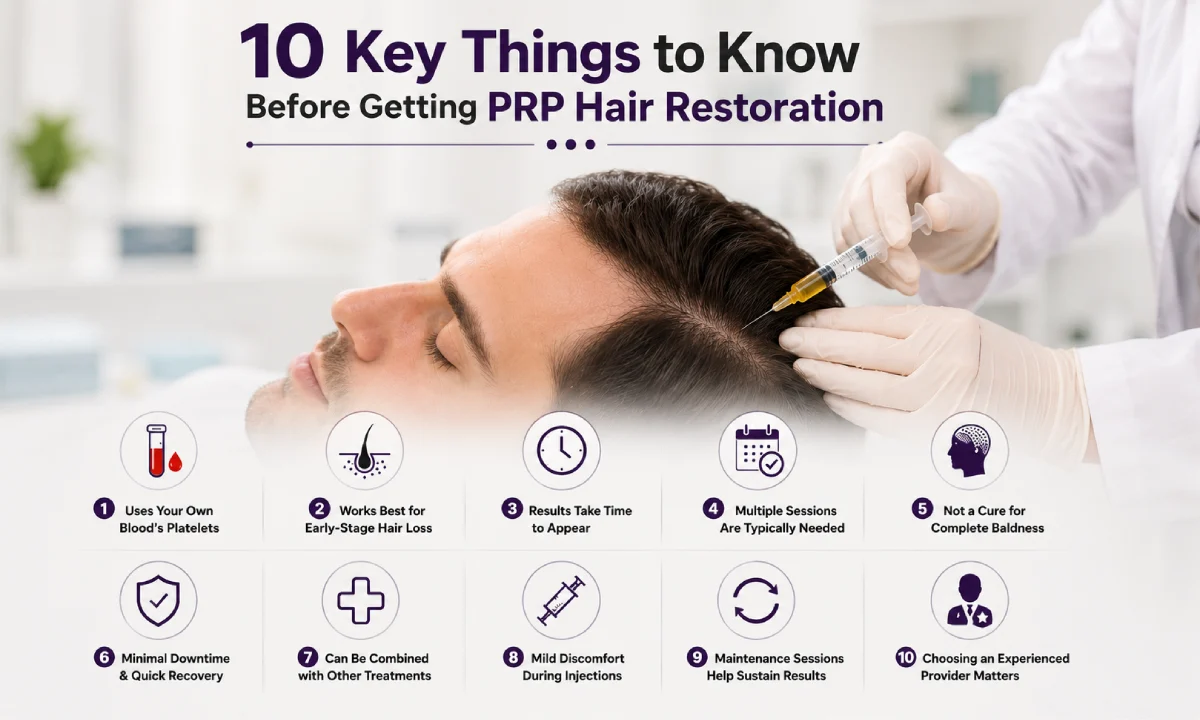
1. It Uses Your Own Blood’s Platelets
PRP, or platelet-rich plasma, is derived from a small sample of your blood, which is processed to concentrate the platelets before being injected into the scalp. Because the treatment relies on your body’s own biological material, there is no synthetic additive involved in the process. This natural approach is part of why PRP has become such a popular option for patients hesitant about more invasive or artificial hair restoration methods that involve synthetic materials or surgical procedures.
2. It Works Best for Early-Stage Hair Loss
PRP hair restoration tends to produce the most noticeable results for patients in the earlier stages of thinning or hair loss, when follicles are still present but weakened rather than fully dormant. Patients with weak, brittle, or thin hair also tend to see meaningful benefit from treatment. Catching thinning early rather than waiting for it to progress significantly tends to make a real difference in how well the scalp and hair follicles respond to treatment overall.
3. Results Take Time to Appear
PRP does not offer instant results, since it works by stimulating your body’s natural healing and growth processes rather than adding volume artificially. Most patients notice gradual improvement over several weeks to months as hair follicles respond to treatment. Patience matters here, since the biological process behind PRP simply takes time to produce visible change, regardless of how the treatment itself is performed or how many sessions have already been completed.
4. Multiple Sessions Are Typically Needed
A single PRP session is rarely enough to produce meaningful, lasting results. Most treatment plans involve an initial series of sessions spaced several weeks apart, followed by periodic maintenance visits to sustain improvement over time. Knowing this upfront helps avoid the disappointment of expecting a single visit to deliver the full extent of what PRP can offer over a complete treatment plan.
5. It Is Not a Cure for Complete Baldness
PRP hair restoration works by reversing the depreciation of existing hair follicles, which means it is generally more effective for thinning hair than for areas where hair loss is already complete. Setting realistic expectations from the start helps avoid disappointment later. A consultation can help clarify whether your specific pattern of hair loss falls into a category likely to respond well to treatment or whether another approach might be more suitable.
6. The Procedure Involves Minimal Downtime
PRP injections are minimally invasive, and most patients return to normal activities immediately after their appointment without needing to plan around extended recovery time. There is no extended recovery period required, which makes it easier to fit into a busy schedule compared to more invasive hair restoration options like surgical transplants.
7. It Can Be Combined with Other Treatments
PRP is often paired with microneedling to enhance collagen production and support even better absorption of the platelet-rich plasma into the scalp. Combining treatments in this way may shorten recovery time and extend how long results last for some patients, depending on their individual response.
8. Mild Discomfort During Injections Is Normal
Some patients experience mild discomfort or a stinging sensation during the injection process, though the discomfort is generally well tolerated and brief, lasting only for the duration of the actual injections. Numbing options may be available to help ease any discomfort during treatment, depending on your provider’s approach and your personal preference.
9. Maintenance Sessions Help Sustain Results
Because PRP works with your body’s natural growth cycles rather than providing a one-time fix, ongoing maintenance sessions are typically needed to sustain results over the long term and keep hair looking its fullest. Skipping maintenance can lead to a gradual return of thinning over time, since the treatment does not permanently alter the underlying hair loss pattern.
10. Choosing an Experienced Provider Matters
The quality of your PRP hair restoration results depends heavily on proper blood processing, injection technique, and an accurate assessment of your specific hair loss pattern from the very first visit. Working with an experienced provider helps ensure the treatment is both safe and appropriately tailored to your needs, rather than applied as a generic protocol.
Who Benefits Most from PRP Hair Restoration
PRP hair restoration tends to suit men and women noticing early thinning, weakened strands, or a general decline in hair density who want a non-surgical option before considering more invasive treatments like hair transplant surgery. It is not typically recommended for patients with fully dormant follicles or complete baldness in the treated area.
If you have been unsure whether your hair loss qualifies as early enough for PRP to help, a consultation is the most reliable way to get an honest answer specific to your scalp and hair loss pattern rather than guessing based on general information alone or comparing your case to someone else’s results.
Ready to Learn More About PRP Hair Restoration
Understanding these ten details makes it much easier to approach PRP hair restoration with realistic expectations. Restore Your Hair with a PRP Hair Restoration Consultation at The Aesthetic Lounge in Lake Forest, IL, where our team can assess your specific hair loss pattern before recommending a treatment plan built around your individual scalp and goals.
If you still have questions about the process, timeline, or what results to expect, contact us and our team will walk you through what PRP hair restoration might look like for you and your specific hair loss goals.